How to Prevent Pickleball Elbow: A Sports Medicine Protocol
Learn how to prevent pickleball elbow with an evidence-based protocol. Get specific exercises, grip tips, and paddle advice. Start protecting your game today!
How to Prevent Pickleball Elbow: A Sports Medicine Protocol
Your elbow shouldn't be the reason to stop playing the game you love. Yet, it frequently sidelines passionate players for weeks, sometimes months, due to a completely preventable injury.
This guide aims to address that today.
What Is Pickleball Elbow, Exactly?
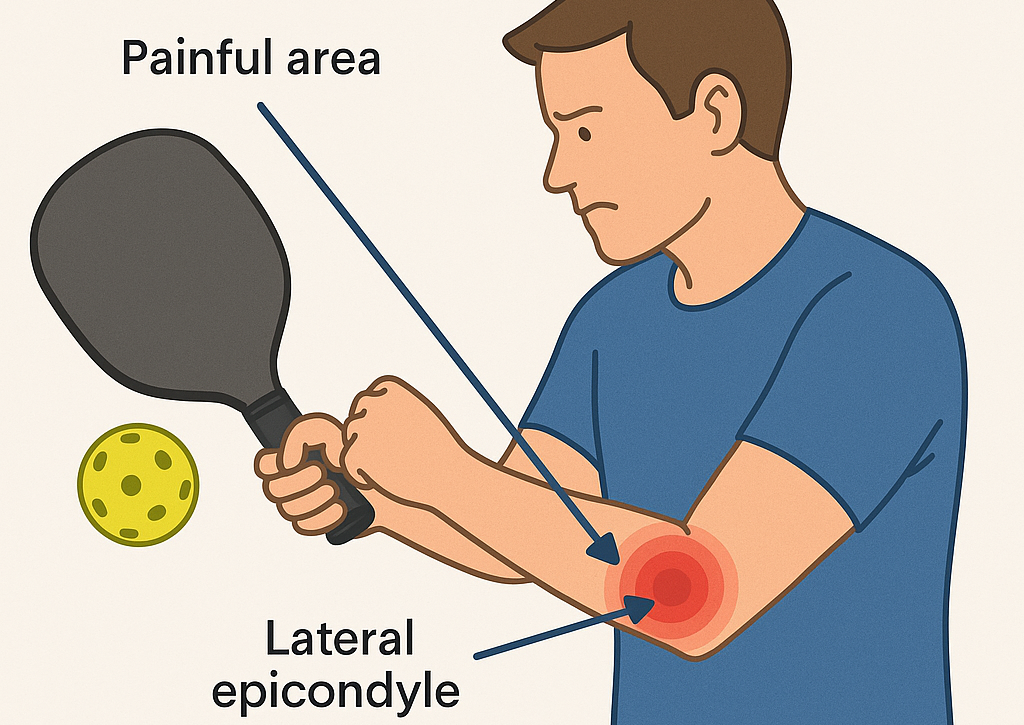
Pickleball elbow is the informal name for lateral epicondylitis — inflammation of the tendons that attach your forearm muscles to the bony bump on the outside of your elbow. It is commonly known as tennis elbow, but pickleball has a few mechanics that make it uniquely problematic.
The repetitive wrist snapping, the two-handed backhand swings, the volleys at the kitchen line — these movements load the same tendons over and over again. Considering that most pickleball players are in their 40s, 50s, 60s, and beyond (tendons become less elastic with age — a natural biological process), this creates a predisposition to injury.
Here's the good news: knowing how to prevent pickleball elbow is largely a matter of following a smart, specific protocol. And that's exactly what will be provided.
Recognize the Early Warning Signs
It is crucial not to wait until the pain is severe enough to hinder daily activities. Early intervention is paramount.
Watch for these signals:
- A dull ache on the outside of your elbow that shows up during or after play
- Morning stiffness in the forearm that eases after 10-15 minutes
- Weakness when gripping your paddle, especially during backhand shots
- Pain when extending your wrist against resistance
- Tenderness directly on the lateral epicondyle — that little bony bump on the outside of your elbow
If one or two of these symptoms appear, it serves as a warning sign. Action should be taken promptly.
The Eccentric Exercise Protocol That Actually Works
Here's where most prevention advice often falls short. Generic advice like "stretch your forearm" and "ice after play" is helpful, but insufficient.
The research is clear: eccentric strengthening is the gold standard for both preventing and rehabilitating lateral epicondylitis. Eccentric exercises work the muscle while it's lengthening — and for the forearm extensors, this builds tendon resilience in a way that concentric-only training simply cannot match.
Here's the recommended protocol:
Tyler Twist (Theraband Flexbar)
This exercise has solid clinical evidence behind it. A study published in the Journal of Orthopaedic & Sports Physical Therapy found it reduced pain by 81% and improved strength by 72% in lateral epicondylitis patients.
How to do it:
- Hold a FlexBar (green for beginners, blue intermediate) vertically with the affected arm, wrist extended.
- Grip the bottom with the other hand.
- Twist the bar into extension with the unaffected hand while simultaneously twisting into flexion with the affected hand.
- Hold, then slowly let the bar unwind — that slow release is the eccentric phase. Do not rush it.
- 3 sets of 15 reps, once daily.
Wrist Extensor Eccentric Lowering
Sit with the forearm on a table, palm facing down, holding a light weight (1-2 lbs to start).
- Use the other hand to lift the wrist into extension.
- Remove the assisting hand and slowly lower the weight over 3-4 seconds.
- That slow lowering is the eccentric load — this is where the benefit occurs.
- 3 sets of 12-15 reps, 3 days per week.
Forearm Pronation/Supination
Hold a hammer or light weight at the handle end.
- With the elbow bent at 90 degrees, slowly rotate the forearm palm-down (pronation) then palm-up (supination).
- 3 sets of 15 reps each direction.
- The offset weight adds rotational load — directly mimicking pickleball mechanics.
Commit to this protocol for 6-8 weeks of consistent effort. Tendons remodel slowly, so consistency is more effective than sporadic intensity.
Grip Technique: The Hidden Culprit
Observation of many pickleball players on the court reveals that grip technique may be the single biggest modifiable risk factor for pickleball elbow that is often overlooked.
Grip pressure is the first thing to address. Most recreational players grip their paddle excessively tightly. A "firm but relaxed" grip is ideal — approximately a 4 on a scale of 1-10. Excessive grip tension is transmitted directly up the forearm extensors to the lateral epicondyle.
Check grip size. A paddle handle that's too small forces a tighter grip to maintain control. To find the correct grip size, measure from the middle crease of the palm to the tip of the ring finger — that's the ideal circumference in inches. Most players fall between 4" and 4.5".
Lead with the elbow on backhands. A common elbow-stressing mistake is a "wristy" backhand where the player flicks through contact with the wrist. Instead, keep the wrist firm and drive through the ball with the whole arm. This generates more power and spares the tendons.
Consider a two-handed backhand. While it may feel unfamiliar initially, distributing the load across both arms dramatically reduces stress on the dominant elbow. Many players over 50 have made this switch and found it beneficial.
Paddle Selection for Elbow Health
Paddle choice significantly impacts the prevention of pickleball elbow. Here's what to consider:
Weight: Heavier paddles (8.5 oz+) generate more power but transfer more vibration and require greater muscular effort to control. For those experiencing elbow issues, a mid-weight paddle (7.5-8.2 oz) is recommended. This may result in a slight reduction in power but offers significant protection.
Core material: Polymer (polypropylene) honeycomb cores are softer and absorb significantly more shock than nomex or aluminum cores. For players with elbow concerns, a polymer core is a crucial consideration.
Surface material: Carbon fiber surfaces are stiffer and transmit more vibration. Fiberglass surfaces are more flexible and forgiving. If elbow discomfort is present, fiberglass deserves serious consideration.
Grip size: As mentioned above — ensure proper fitting. An oversized grip requires less grip force, leading to less tendon strain.
Vibration dampeners: Some paddle brands now offer built-in dampening systems. While not a complete solution, they can reduce the impact of repetitive forces.
Your Pre-Play Warm-Up Routine
Cold tendons are more susceptible to injury. Five minutes of targeted warm-up can make a meaningful difference in injury risk.
Dynamic wrist circles: 20 reps each direction, full range of motion.
Forearm extensor stretch: Arm extended, palm down, gently pull fingers toward the floor with the other hand. Hold 30 seconds, 3 times. A mild pull along the top of the forearm should be felt.
Forearm flexor stretch: Same arm position but pull fingers back toward the ceiling. Another 30 seconds, 3 times.
Light shadow swings: Mimic backhand drive, forehand, and overhead — without a ball. Allow tissues to activate before engaging in strenuous activity.
This adds approximately 5 minutes to a pre-game routine, a worthwhile investment for injury prevention.
Recovery: What Is Done After Play Matters
Prevention continues after the game concludes.
Ice if needed. If any soreness is felt after play, 10-15 minutes of ice on the lateral elbow helps manage inflammation. Avoid icing before play, as blood flow is desired for activity.
Consider a counterforce brace. These straps, worn just below the elbow, disperse tendon forces during play. They do not resolve the underlying problem but can reduce symptom load while strength is being built. Wear it during play, not continuously.
Respect rest days. Playing every day without recovery is a fast track to chronic tendinopathy. Incorporate at least one or two rest days per week, especially when increasing playing time.
Hydration and nutrition. Tendons are largely composed of collagen. Vitamin C supports collagen synthesis — a simple supplement strategy worth considering. Staying hydrated is also important; dehydrated tissue is less resilient.
When to See a Medical Professional
If a solid prevention protocol has been followed and persistent pain is still experienced after 4-6 weeks, it is time for an evaluation. A sports medicine physician or physical therapist can rule out other diagnoses (radial tunnel syndrome, for instance, mimics lateral epicondylitis), order imaging if needed, and potentially recommend treatments like corticosteroid injections or platelet-rich plasma therapy.
Do not push through sharp, worsening pain. This can escalate a minor problem into a major one.
Play Smart, Play Long
Learning how to prevent pickleball elbow isn't complicated, but it does require intention. Eccentric strengthening, smart grip mechanics, the right paddle, a proper warm-up, and adequate recovery — combining these elements builds a strong defense against one of pickleball's most common injuries.
Many players have successfully extended their time on the court by following this type of protocol. Players deserve to continue enjoying the game they love for decades to come.
A free guide is available at PlayPickleballForever.com that outlines a complete elbow-protection protocol — including exercises, paddle selections, warm-up routines, and more. It is free, practical, and could help preserve a player's season.
Take care of those elbows. The court will be waiting.